y≥x+4
−4≤x2+y2+4(x−y)≤0
The second condition contains two inequalities:
x2+y2+4(x−y)≥−4
x2+y2+4(x−y)≤0
Starting with: x2+y2+4(x−y)≥−4
Expand: x2+y2+4x−4y≥−4
Rearrange: x2+y2+4x−4y+4≥0
Complete the square:
For x terms: x2+4x=(x+2)2−4
For y terms: y2−4y=(y−2)2−4
Substituting: (x+2)2−4+(y−2)2−4+4≥0
Simplifying: (x+2)2+(y−2)2≥4
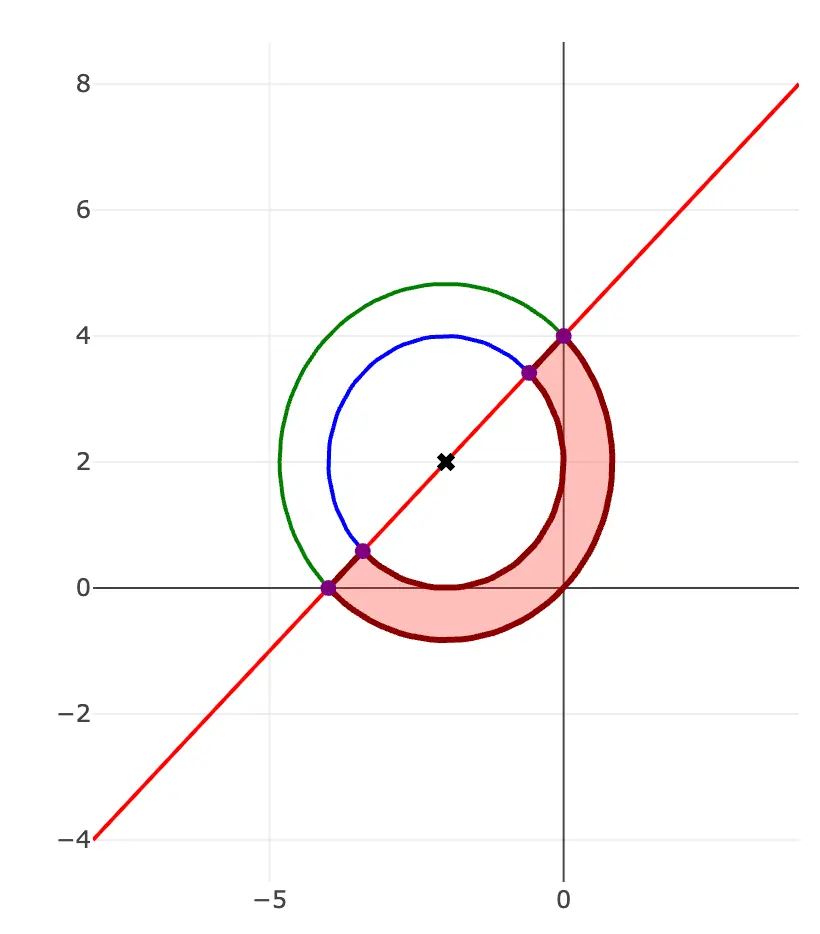
This is the region outside or on a circle with center (−2,2) and radius 2.
Starting with: x2+y2+4(x−y)≤0
Expand: x2+y2+4x−4y≤0
Add 8 to both sides: x2+y2+4x−4y+8≤8
Complete the square: (x+2)2+(y−2)2≤8
This is the region inside or on a circle with center (−2,2) and radius 8=22.
We need the region satisfying all three conditions:
Above the line y=x+4
Outside the smaller circle: (x+2)2+(y−2)2≥4
Inside the larger circle: (x+2)2+(y−2)2≤8
Check if the line y=x+4 passes through center (−2,2):
When x=−2: y=−2+4=2 ✓
The line passes through the center of both circles, dividing each into two equal halves.
Area of larger circle =π×(8)2=8π
Area of smaller circle =π×22=4π
Area between circles =8π−4π=4π
Since we only want the half above the line:
Required area =21×4π=2π
Therefore, the area is 2π square units.
